

Solar Almanac – GHA and Declination for Sextant Navigation (2026–2040), calculated with high precision using the JPL DE440s ephemerides.
This Solar Almanac – GHA and Declination for Sextant Navigation (2026–2040) is an invaluable resource for navigators seeking reliable data for future voyages.
Coordinates of the Sun’s apparent center — true equinox of date
UT hours (UTC from the ship’s clock)
The difference between UTC and UT1 remains less than 1 second and is negligible for astronomical navigation.
The accuracy of the ephemerides remains stable over the entire period covered.
1 No progressive drift.
2 No discontinuity at year changes.
3 No cumulative calculation error.
Symbols used:
GHA (Greenwich Hour Angle of the Sun)
Dec (Declination of the Sun)
d (Change in declination per hour)
pp (Increment of GHA for minutes and seconds)
UT (Universal Time (UTC))
The idea is to go to sea carrying only a few pages of ephemerides and a scientific calculator — or, for the purists, a set of logarithm and azimuth tables.
To determine a Sun line of position, only a few pages are required:

1) Annual ephemerides
(19 pages) giving the Sun’s GHA and declination for the year.


2) Sextant Altitude Correction Tables for the Sun
(1 page)

3) Sun’s Increments and Corrections Table
(20 pages) used to obtain the increment (pp) of the Sun’s GHA.
These pages can be omitted if you are comfortable calculating the increment (pp) with a scientific calculator. See page “increment of the sun’s hour angle.”


Sun Sight Worksheet
(1 page)
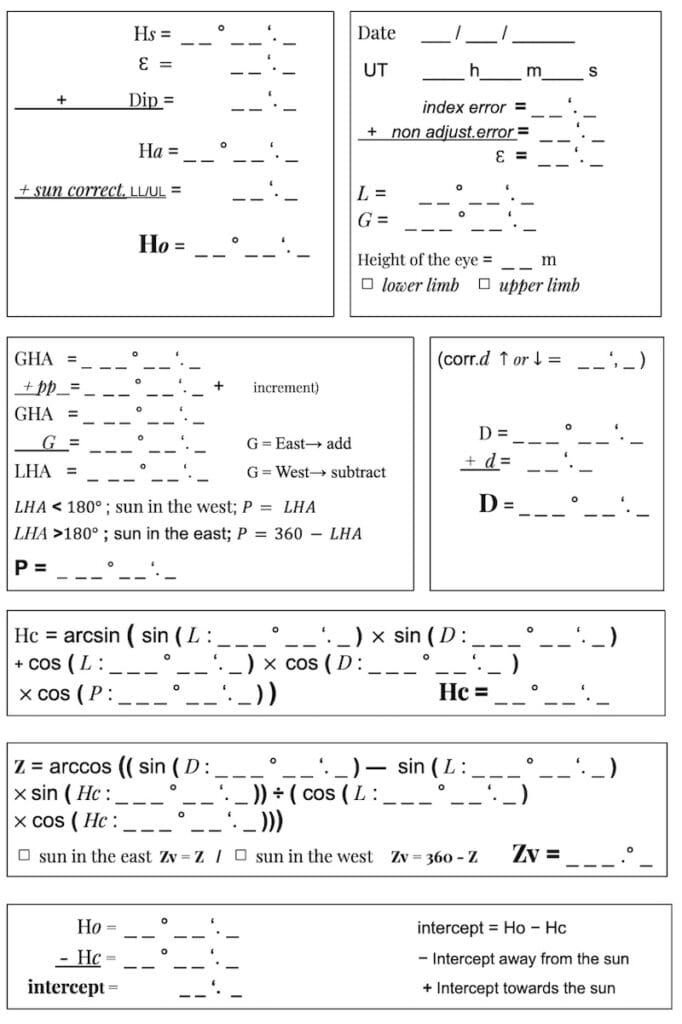
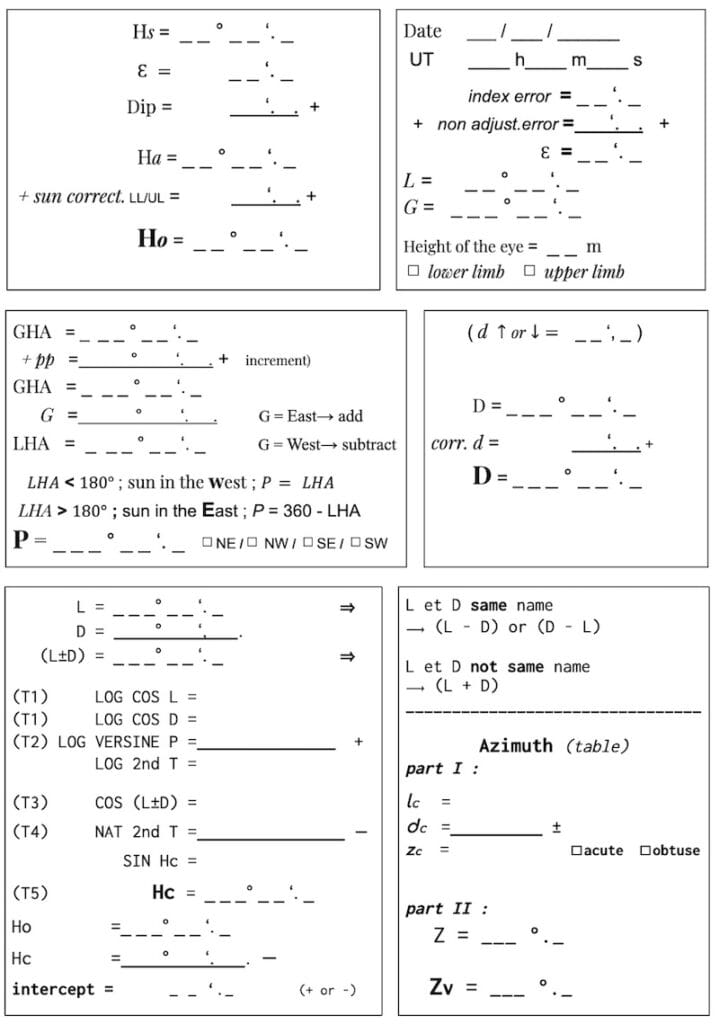

Solar Almanac – GHA and Declination for Sextant Navigation (2026–2040)
Example of using the Solar Almanac (2026–2040) to complete the corresponding entries in the calculation grid.
Of course, in the eight exercises available on this website—including the “La Rochelle” exercise—these steps are explained in much greater detail. This example simply serves as a brief reminder.

First Step: Observe the Sun’s altitude with the sextant (Hs) and record the corresponding time, the date, the dead reckoning position, the height of eye, the index error, and the use of the Sun’s lower limb.
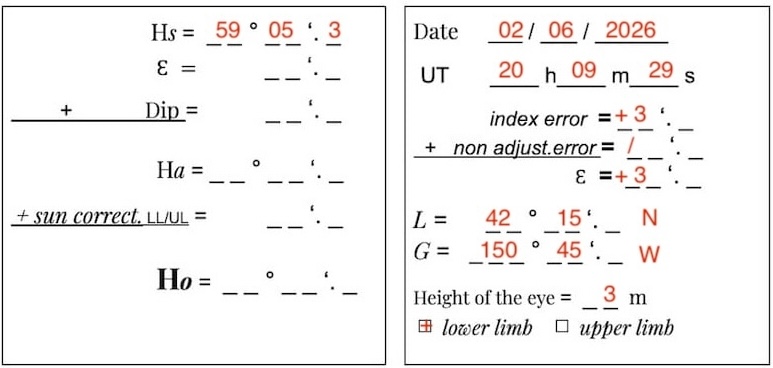
Step 2: Calculate the Sun’s true altitude using the Sextant Altitude Correction Tables for the Sun.


Step 3: Find the GHA and the declination in the Solar Almanac 2026.

June 2, 2026 at 20:00 UT:
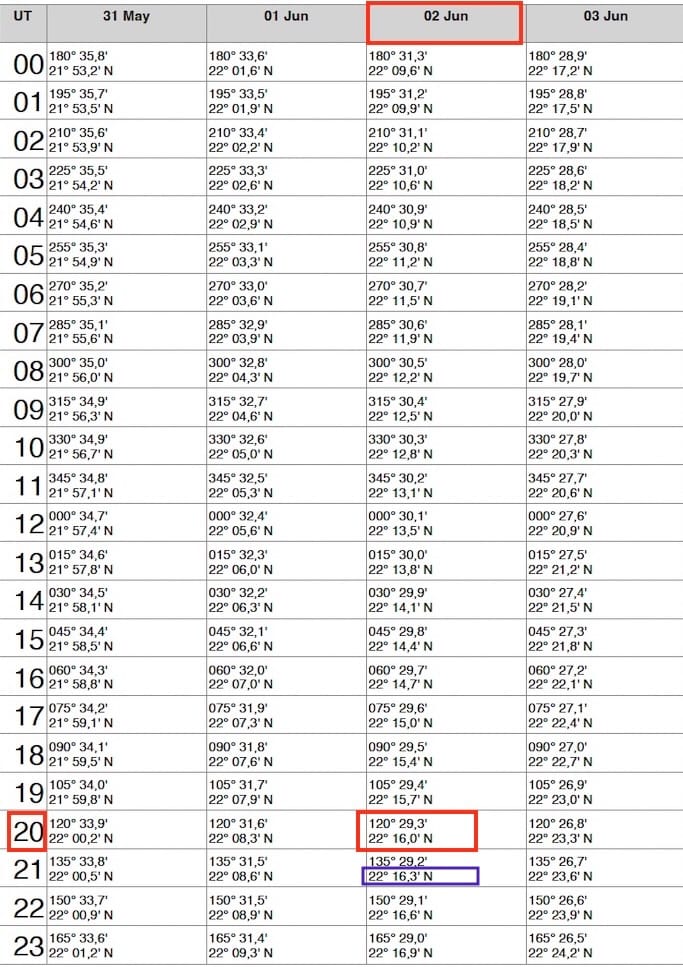
Note: The declination increases by about 0.3′ per hour on that day. ( d = 0,3′ ↑.)
Step 4: Calculate the GHA and declination for the exact time of observation.
The increment tables are used here to obtain pp.

Exact time: 20:09:29 UT

Hourly change d = +0.3′
Correction for 9m29s = +0.1′
First section of the worksheet completed


Step 5: Complete the calculation table, either with a scientific calculator or with the help of the tables.

Hc = 59° 20.6′ ; Zv = 121.9° ; intercept = -0.1′
If you have difficulty calculating these results, refer to the page Altitude and Azimuth of the Sun with a Scientific Calculator.
For the tables, see the exercise “La Rochelle”. After completing the first part of the worksheet, choose the tables instead of the calculator.

Astronomical Data Source
The solar positions (GHA and Declination) used in this almanac are computed from the JPL DE440s planetary ephemeris, developed by the Jet Propulsion Laboratory (NASA).
Released in 2020, DE440s provides high-precision positions of the Sun, Moon, and planets based on decades of observational data (spacecraft tracking, radar ranging, and lunar laser measurements).
Its use ensures that the solar data for 2026–2040 are derived from a modern scientific standard consistent with professional astronomical references.