Comparison of Sight Reduction Methods.
The “La Rochelle Core Exercise” provides a step-by-step introduction to calculating the Sun’s Local Hour Angle (LHA) and declination (D) at the time of observation, as well as applying the necessary corrections to convert the sextant altitude (Hs) into the observed altitude (Ho).
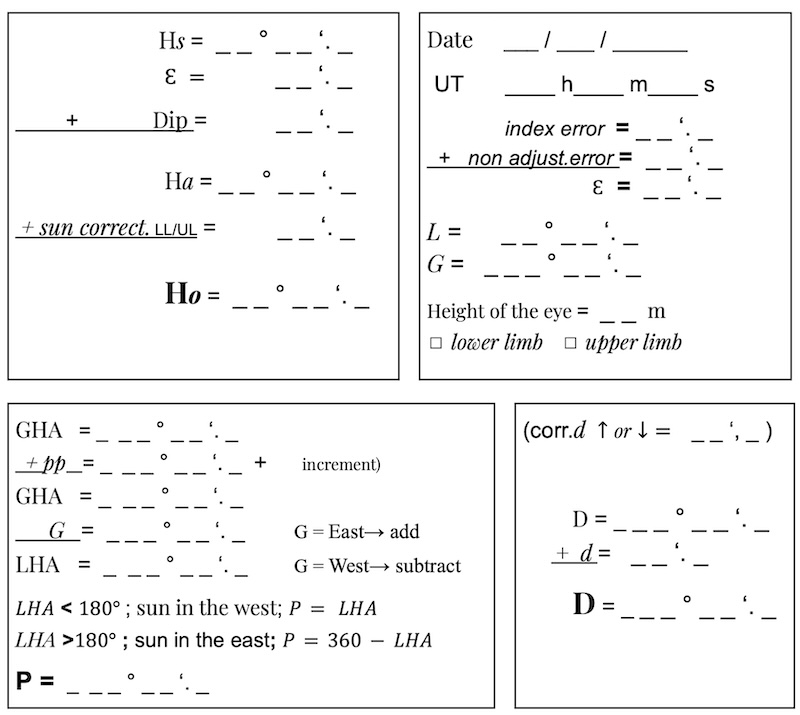
Once these essential calculations are complete, EasySextant offers four different methods for determining your Line of Position (LOP) at sea.
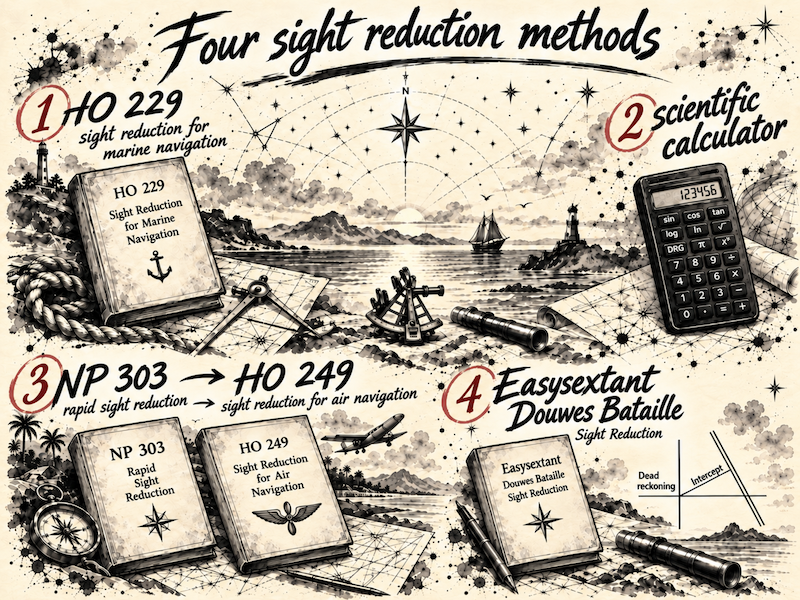
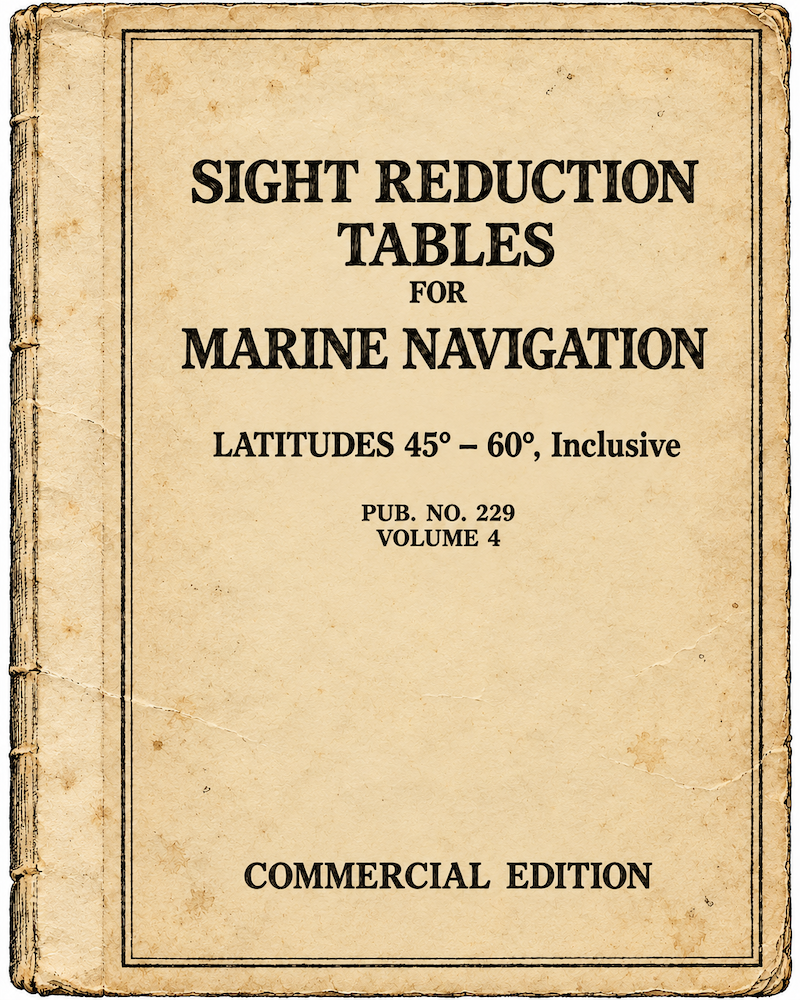
HO 229 Sight Reduction Tables (US): A method using highly accurate and comprehensive American tables, specifically designed for marine navigation.
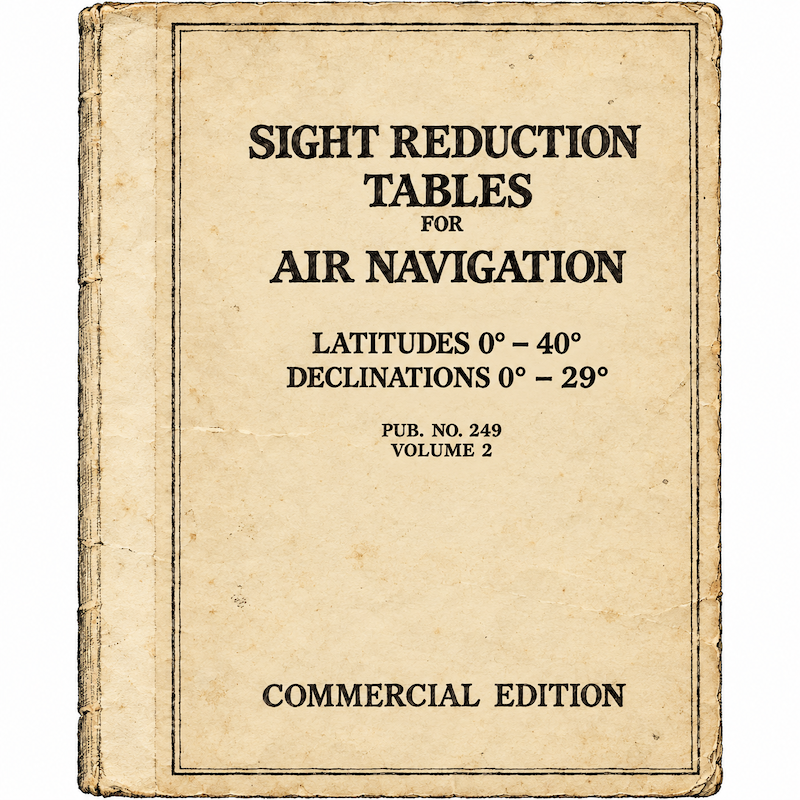
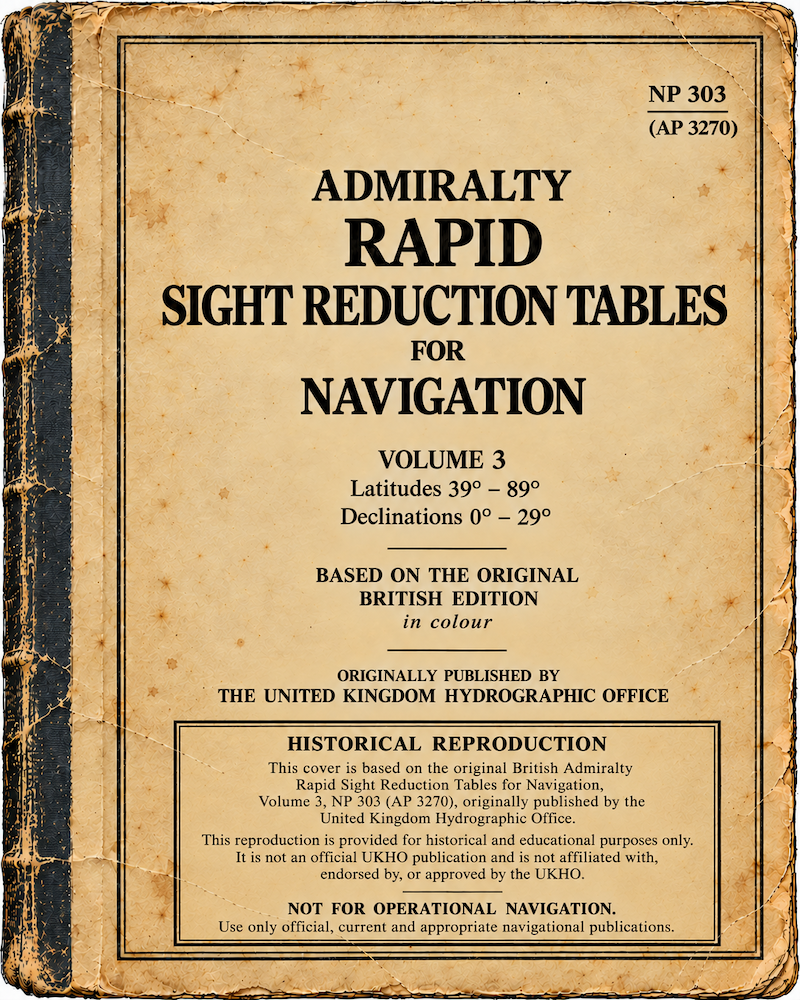
HO 249 / NP 303 Sight Reduction Tables: The American and British equivalents, respectively, of a simplified tabular method originally developed for aviation, designed for speed and ease of use, and also widely employed in marine navigation.
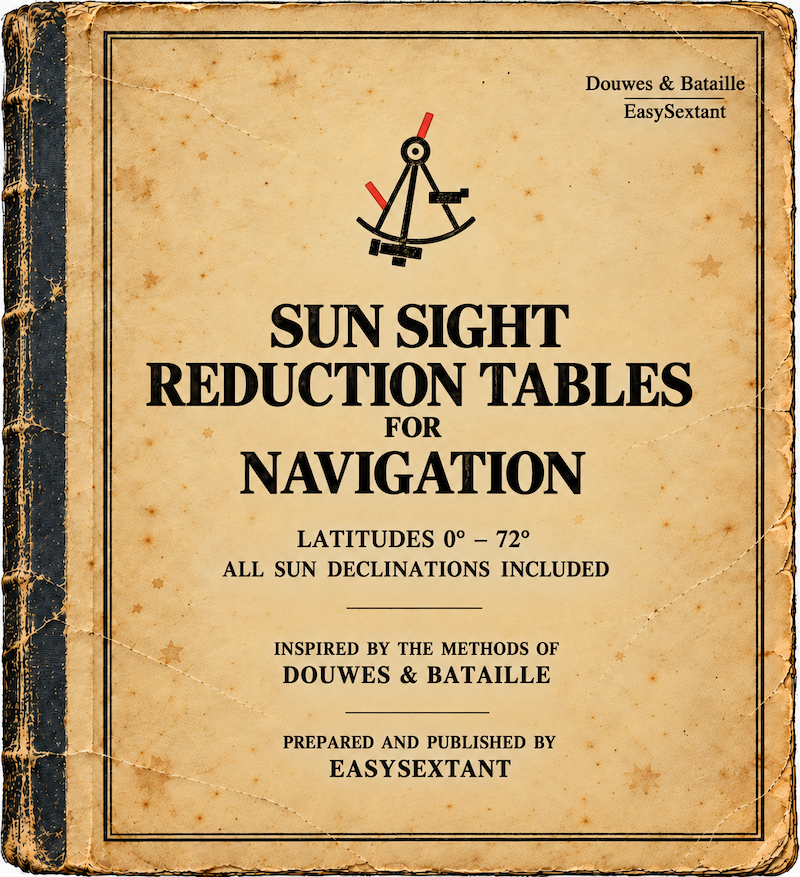
EasySextant (Douwes–Bataille) Sight Reduction Tables: A compact method employing logarithms alongside other mathematical techniques to perform calculations directly from the estimated position, primarily suited to observations of the Sun.
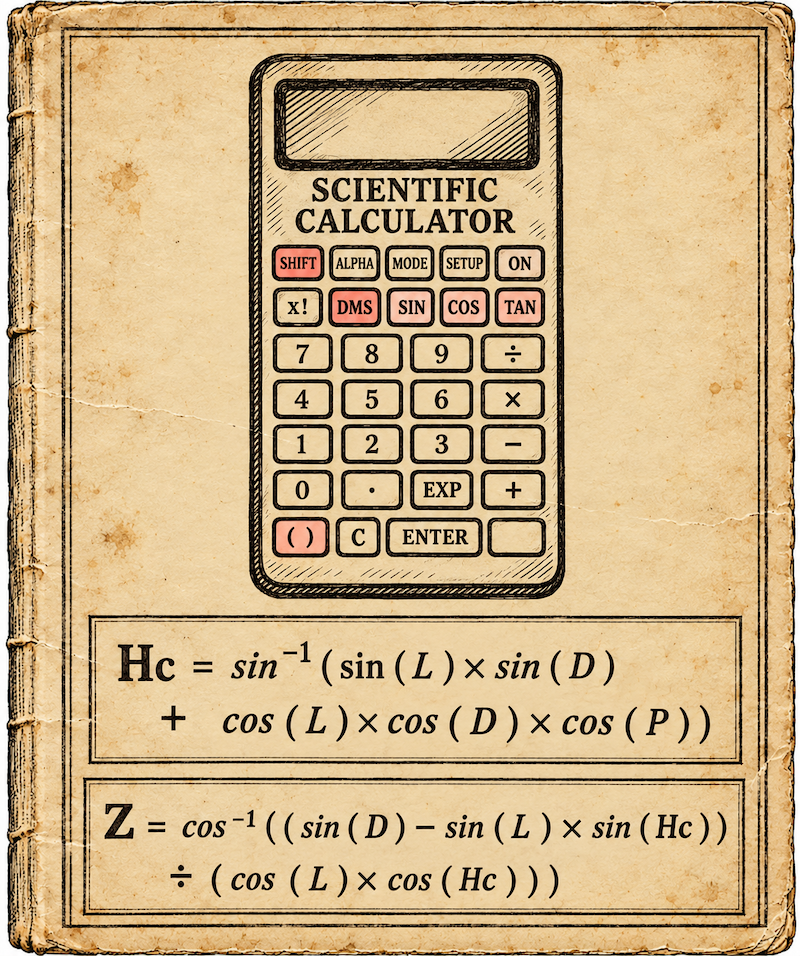
Scientific Calculator and Trigonometric Formulas: An accurate, direct calculation method commonly taught in maritime schools, requiring a good understanding of trigonometric formulas and the use of a scientific calculator.
Note 1: The American sight reduction tables (HO 229 and HO 249), as well as the EasySextant sight reduction tables, can be downloaded free of charge from this website.
Note 2: A more detailed comparison of the four methods is available on this page.
COMPARISON OF FOUR CELESTIAL NAVIGATION METHODS
HO 229
HO 249 / NP 303
EasySextant
Scientific Calculator
ADVANTAGES AND DISADVANTAGES
1. HO 229 — Accuracy Above All
HO 229 is an American publication intended for marine navigation. It uses the Marcq de Saint-Hilaire intercept method with an assumed position.
Advantages
- Very high accuracy: calculated altitude to 0.1′ and azimuth to 0.1°.
- Virtually universal coverage of latitudes, declinations, and navigational celestial bodies.
- Reliable results and documented tabular errors.
- Entirely manual operation, requiring neither electricity nor electronics.
- Special procedures for difficult situations, particularly near the zenith.
Disadvantages
- Six volumes, heavy and bulky aboard a small sailing yacht.
- Looking up values and performing interpolations can be tedious.
- Risk of reading or transcription errors.
- Requires selecting an assumed position.
- The additional precision is often of limited practical benefit given the uncertainties inherent in sextant observations.
Overall assessment: A highly accurate and comprehensive method, but relatively bulky and demanding in terms of table handling.
2. HO 249 and NP 303 — Speed and Efficiency
Originally designed for air navigation, HO 249 is also widely used in marine navigation. Its underlying principle is similar to that of HO 229.
The British NP 303 (Rapid Sight Reduction Tables) follows essentially the same method as the American HO 249 tables.
Advantages
- Fast and relatively simple to use.
- Three volumes instead of six, including two for routine observations of the Sun, Moon, and planets.
- Accuracy generally sufficient for celestial navigation at sea.
- Volume I is particularly convenient for multiple-star sights.
- Completely independent of electronics.
Disadvantages
- Lower precision than HO 229: altitude to the nearest minute of arc and azimuth to the nearest degree.
- Position errors may be amplified by rounded azimuths when lines of position intersect at unfavorable angles.
- Declination limited to 29° in Volumes II and III, but sufficient for EasySextant’s educational purpose, which focuses exclusively on Sun sights.
- Requires the use of an assumed position.
- Volume I, specifically designed for star sights, is epoch-dependent and updated every five years, unlike the other tables used by EasySextant, which remain valid indefinitely. It is therefore not relevant to EasySextant’s educational purpose, which focuses exclusively on Sun sights.
Overall assessment: An excellent compromise between accuracy, simplicity, and speed, particularly well suited to routine offshore navigation.
3. EasySextant — Compactness and Independence
EasySextant uses a logarithmic method inspired by Douwes to calculate altitude, together with Bataille’s tables to determine azimuth.
Advantages
- Extremely compact: 55 pages of permanent tables.
- Can be used without a calculator, battery, or electricity.
- Altitude calculated directly from the estimated position, without an assumed position.
- An educational method that helps users better understand astronomical calculations.
- Designed to provide a calculation accuracy of approximately one nautical mile, although external factors such as sextant observation errors, horizon conditions, and timekeeping inaccuracies may reduce the accuracy of the final position.
- Particularly useful as an independent backup system aboard a small sailing yacht.
Disadvantages
- Requires several table lookups and logarithmic operations.
- Numerical precision limited by the use of four decimal places, resulting in a potential calculation error ranging from approximately 0.1 to 1 nautical mile.
- EasySextant has specific limitations at high geographical altitudes concerning certain azimuth configurations. For this reason, its azimuth tables have been limited to a maximum geographical altitude of 72°, compared with 89° in the original Bataille tables.
- The current system on this website is primarily intended for observations of the Sun.
Overall assessment: A compact, self-contained method, particularly useful for solar navigation, provided its limitations are understood.
4. Scientific Calculator — Trigonometric Formulas
This method consists of solving the navigational triangle directly using sine, cosine, tangent, and their inverse trigonometric functions.
The fundamental formula for calculated altitude is:
sin Hc = sin L × sin D + cos L × cos D × cos LHA
Azimuth is obtained using a second trigonometric relationship. The correct quadrant must be determined from the Local Hour Angle (LHA), taking into account whether the celestial body lies east or west of the observer’s meridian. The calculator must be set to degree mode.
cos Z = ((sin(D) − sin(L) × sin(Hc)) / (cos(L) × cos(Hc)))
This method is included in celestial navigation instruction and examinations at many maritime training institutions. Whether it is compulsory depends on each school’s curriculum and examination regulations.
Advantages
- Excellent numerical accuracy with a suitable calculator.
- Direct calculation from the coordinates of the estimated position.
- No need for bulky sight-reduction tables.
- General method applicable to different celestial bodies.
- Provides a direct understanding of the mathematical relationships within the navigational triangle.
- An important method in the theoretical training of maritime officers.
Disadvantages
- Relatively difficult to learn: requires mastery of formulas, signs, quadrants, and trigonometric functions.
- After a long period without practice, the formulas and their application are easily forgotten.
- Scientific calculators differ in layout and data-entry procedures.
- Changing calculator models may cause hesitation or calculation errors.
- Careful attention must be paid to degrees, minutes, seconds, and angular settings.
- Depends on an electronic device and its power supply, unlike the three preceding methods.
Overall assessment: A mathematically precise method and an essential element of training, but one whose manual application requires practice and familiarity with the calculator being used.
COMPARISON AND CONCLUSION
5. Comparative Table
| Criterion | HO 229 | HO 249 NP 303 | Easy Sextant | Scientific Calculator |
| Numerical accuracy | Very high | Good | Good | Very high |
| Speed once mastered | Moderate | Fast | Moderate to Fast | Fast |
| Ease of learning | Moderate | Good | Moderate | More difficult |
| Resuming use after a long break | Fairly easy | Fairly easy | Review advisable | Often difficult |
| Space required | Conside-rable | Moderate | Very little | Very little |
| Assumed position | Yes | Yes | No | No |
| Depend-ence on electronics | No | No | No | Yes |
| Applicable celestial bodies | All | Several | Primarily the Sun | All |
| Main strength | Accuracy | Speed | Independence | Direct calculation |
| Main weakness | Bulk | Rounded azimuth | Skill require- ments | Skill require-ments and electronics |
6. Training and Retention of Skills
The trigonometric method using a calculator plays an important role in celestial navigation education. It enables students to learn the mathematical foundations of altitude and azimuth calculations.
However, passing an examination does not necessarily mean retaining long-term proficiency in this method.
After several months or years without practice, a navigator may have forgotten the formulas, sign conventions, inverse trigonometric functions, or certain calculation steps. Even an experienced maritime officer may need to consult previous notes before regaining fluency.
Furthermore, replacing a calculator with a different model may change the sequence of keystrokes and data-entry procedures, increasing the risk of error.
By contrast, paper-table methods rely on printed and relatively stable procedures. Navigators can consult the instructions directly in the publication without depending on a particular device.
Nevertheless, table-based methods also require a minimum amount of practice to avoid reading, sign, and interpolation errors.
7. Theoretical Accuracy Versus Practical Accuracy
Greater mathematical precision does not automatically guarantee a more accurate position at sea.
Sextant observation errors, horizon conditions, altitude corrections, accurate timekeeping, and the geometry of intersecting lines of position may have a greater influence than differences in numerical precision between the methods.
Thus, scientific calculators and HO 229 produce highly precise numerical results, but their theoretical superiority may have little practical significance under ordinary observation conditions.
8. General Conclusion
These four methods share the same objective but address different needs.
HO 229 emphasizes maximum accuracy and versatility, at the cost of considerable bulk.
HO 249 emphasizes speed and simplicity, while providing accuracy generally satisfactory for marine navigation.
EasySextant emphasizes compactness, independence, and solar sight reduction directly from the estimated position. Its advantages are particularly evident aboard small sailing yachts.
The scientific calculator enables direct and highly accurate calculations while remaining an important tool in celestial navigation education. However, it requires mastery of formulas and procedures, skills that may deteriorate without regular practice.
The essential distinction is therefore also one of independence: the three paper-table methods remain usable without any electrical power, whereas the calculator requires a functioning electronic device.
For training purposes, the trigonometric method retains its full value because it teaches the mathematical foundations. For practical navigation, particularly as a backup system, a familiar paper-table method that is practiced regularly can provide an additional margin of safety.
Ultimately, the best method is not necessarily the one that produces the greatest number of decimal places, but the one the navigator can use correctly, quickly, and confidently, even after a long period without practice and in the absence of electronic equipment.